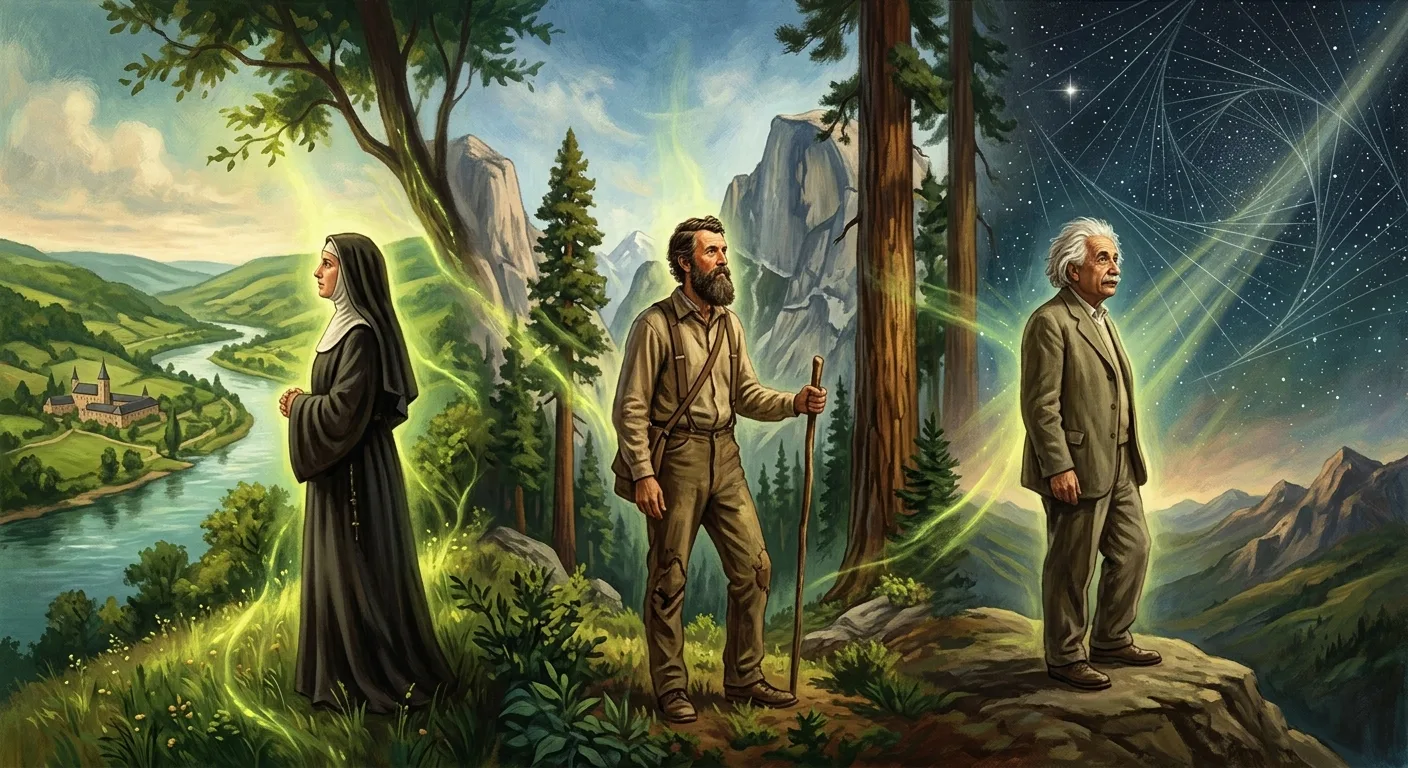
If you found this site through John Muir — through a love of Yosemite, the Sierra Club, or the idea that wilderness is a cathedral — you may not have realized that the film you watched is part of something larger. The Unruly Mystic: John Muir is the second film in a documentary series that began with a 12th-century German abbess named Hildegard von Bingen. A fifth film, on Albert Einstein, is in post-production.
That might seem like an unlikely pairing. What does a medieval mystic have to do with the father of the national parks? And what does either of them have to do with the physicist who gave us the theory of relativity?
The answer is everything. And understanding the thread that connects them changes how you see each one.
What Is an Unruly Mystic?
The word mystic tends to make people nervous. It conjures vague spirituality, incense, detachment from the world. But that is almost the opposite of what these figures represent.
A mystic, in the oldest sense, is someone who has had a direct encounter with something larger than themselves — with the sacred, the transcendent, the alive-ness of the world — and has been permanently changed by it. Not changed into passivity. Changed into action.
The unruly part is what happens next. Every subject in this series broke with the acceptable framework of their time. Hildegard, a woman in medieval Europe, wrote theology, composed music, challenged popes, and founded two monasteries. John Muir, a farmer’s son with no formal scientific training, redrew the map of how Americans understood the land beneath their feet. Einstein, a patent clerk, rewrote physics with thought experiments conducted on a tram.
None of them asked permission. All of them paid a price. And all of them left the world permanently different.
Hildegard and Muir: The Parallels Are Startling
Hildegard von Bingen was born in 1098 in the Rhineland. John Muir was born in 1838 in Dunbar, Scotland. Seven hundred years apart, and yet the shape of their inner lives is remarkably similar.
Both experienced nature as inherently sacred. Hildegard called it viriditas — the greening power of God — a living force she saw animating every plant, every season, every human body. Muir didn’t use that word, but he described the same force. Walking through Yosemite, he wrote of trees that were “sermons,” of glaciers that were “God’s writing,” of wilderness as the place where the human soul could finally hear what it had been trying to say all along.
Both were prolific writers who wrote with urgency, as though they knew their audience was the future as much as the present. Hildegard’s letters survive to popes and emperors. Muir’s essays changed federal land policy. Neither wrote for an academic audience. Both wrote to wake people up.
Both were healers in their own way. Hildegard’s Physica catalogued hundreds of natural remedies still used in German herbalism today. Muir’s prescription was simpler: go outside. Spend time in wild places. Let the mountains do what medicine cannot.
“The clearest way into the Universe is through a forest wilderness.”
John Muir
Hildegard would not have phrased it that way. But she would have agreed completely.
The Spiritual Awakening That Started It All
The Unruly Mystic series exists because filmmaker Michael Conti had his own encounter with something larger than himself. Not in a church, and not in a lecture hall — in the wilderness of Colorado, and later in the ruins of Hildegard’s abbey in Disibodenberg, Germany.
The first film, The Unruly Mystic: Saint Hildegard (2014), began as an attempt to understand who this woman was — a figure Conti had encountered through her music and her writing, and who seemed to have something urgent to say to the present moment. The film premiered in Germany and has screened at spiritual centers, universities, and Catholic parishes across Europe and North America.
The second film, The Unruly Mystic: John Muir (2018), grew from the same impulse but turned toward the natural world — toward the question of what it means to live in right relationship with the land, and what happens to a society that loses that relationship. The film toured 20 cities across seven states and screened at Yosemite National Park.
Then came two companion films about Hildegard specifically: Hildegard Spricht (2022) in German, and Hildegard Speaks (2023) in English — both available on YouTube, bringing her voice to audiences who might not find their way to a theatrical screening.
And now: Seeing First Light, the Einstein film, currently in post-production.
Why Einstein?
Einstein belongs in this series for the same reason Hildegard and Muir do: he understood the world as alive with meaning, not merely as a collection of measurable forces.
He called himself a “deeply religious nonbeliever.” What he meant was that he felt a profound sense of awe — what he described as a “cosmic religious feeling” — in the presence of the order and beauty of the universe. He was suspicious of any religion that reduced the sacred to rules and rewards. But he never doubted that there was something there to be in awe of.
He was also, like Hildegard and Muir, a refugee from conventional thinking. He failed his entrance exam to university. He worked as a patent clerk while developing the special theory of relativity. He published four world-changing papers in a single year — 1905 — while holding down a day job. He was, by any standard definition, an outsider who changed everything from outside the gates.
And like Muir, he understood the stakes. His later years were consumed by the question of nuclear weapons — by the responsibility that comes with knowledge, and by the urgent need for humans to develop a conscience that could keep pace with their capability.
What the Series Is Really About
Each film in the Unruly Mystic series asks the same underlying question: What happens when a human being pays deep attention?
Hildegard paid deep attention to the body, to music, to the living world, and to the voice she heard inside herself that she was told to ignore. She didn’t ignore it. She wrote it down, set it to music, built institutions around it.
Muir paid deep attention to the Sierra Nevada, to glaciers, to the rings of ancient trees, to the faces of the people he walked beside. He looked until he understood, and then he wrote until others could see what he saw.
Einstein paid deep attention to light. To what it would mean to ride alongside a beam of light at the speed of light. To the geometry of space and time. He thought his way into the structure of the universe through pure sustained attention.
None of them did this alone. All of them were formed by their landscapes — Hildegard by the Rhineland forests and rivers, Muir by the Scottish coast and then the American wilderness, Einstein by the cramped streets of Zurich and the open conceptual spaces of mathematics. Place shaped them all.
Watch, Walk, and Connect
If you have only seen The Unruly Mystic: John Muir, the Saint Hildegard film is a natural companion — and it will likely change how you hear Muir. Once you understand Hildegard’s viriditas, Muir’s language about the living world stops sounding like poetry and starts sounding like theology.
Both films are available to stream on Amazon Prime Video. Hildegard Speaks and Hildegard Spricht are on YouTube.
And if you want to go deeper — there are walks. The Walk in the Footsteps of John Muir follows his childhood journey across Scotland’s Central Belt. The Saint Hildegard Way traces her path through the Rhineland. Both are 10-day immersions in landscape and legacy. Both have been led by Michael Conti.
The mystics left trails. You can walk them.
The Unruly Mystic film series is produced by Crazy Wisdom Films, a production company founded by Michael M. Conti. Learn more about the full series, the filmmaker, and upcoming projects at theunrulymystic.com.